News & Notices

Mere Fire Station Consultation
Mere Town Council is attending meetings and actively developing a strategy to prepare its formal response to the public consultation regarding Dorset & Wiltshire Fire and Rescue Service’s proposal to close Mere Fire Station.
We urge residents not to rush into responding to the consultation. Please take time to carefully review all the available information and scrutinise the data before forming your views. The relevant reports can be accessed on the Dorset & Wiltshire Fire and Rescue Service website here:
https://www.dwfire.org.uk/fire-rescue-authority/meetings/fire-rescue-authority/
We are committed to involving the community throughout this process. The Town Council will be holding public meetings and preparing guidance to help inform and advise residents on how best to respond. There will also be public engagement sessions hosted by the Fire Service, and we will share further details of these, along with information on how you can support and get involved.
This is an important matter for our community, and we are determined to ensure that local voices are clearly heard. Further updates will be provided in due course.
Vacancy for Town Councillor February 2026
Mere Town Council Town Clerk – Mrs. L. C. Wood
Duchy Manor, Springfield Road, Mere, Warminster, Wiltshire BA12 6EW
Phone: 01747 860701
e-mail: lindseywood@merewilts.org www.merewilts.org
VACANCIES FOR TOWN COUNCILLOR
Mere Town Council has a vacancy which will be filled by co-option at a meeting to be held on Monday, 13th April 2026
Those interested in becoming a Town Councillor should submit an expression of interest to the Town Clerk either by letter, email or telephone (contact details above) by 27th February 2026
Candidates will be given information on eligibility and will be invited to submit an application form & personal statement.
Further information is available on the Town Council’s website: www.merewilts.org
Wessex Flood Recovery Guide 2026
Wessex Flood Recovery Guide 2026
Essential information and support after flooding
If you have been affected by flooding
If it is not possible to remain in your home, your local authority may be able to help with temporary accommodation, welfare support, or financial assistance.
Find your local council: www.gov.uk/find-local-council
Report flooding
If your home or business has flooded, please report it as soon as possible:
www.gov.uk/report-flood-cause
Reporting flooding helps agencies respond and plan future flood prevention.
Insurance
If you are insured, contact your insurer as soon as possible.
Do not carry out repairs that could prevent damage assessment.
Some insurers offer up to £10,000 through Flood Re’s Build Back Better scheme for flood resilience measures.
www.floodre.co.uk/buildbackbetter
If you are not insured, contact your local council or the National Flood Forum (01299 403055).
Returning home safely
Only return when emergency services say it is safe.
Do not turn on gas, electricity, or water until checked by a qualified engineer.
Cleaning up after flooding
Take photos and keep records of all damage.
Floodwater is contaminated – take care to protect your health.
Advice on cleaning and drying your home:
www.gov.uk/how-to-recover-from-flooding
Important contacts
Emergency (life in danger): 999
Floodline (24 hours): 0345 988 1188
Environment Agency incident hotline: 0800 807060
Wessex Water: 0345 600 4600
National Flood Forum: 01299 403055
British Red Cross: 0344 871 1111
Samaritans (24 hours): 116 123
Flood warnings and future preparation
Check current flood warnings and sign up for alerts: www.gov.uk/flood
Consider Property Flood Resilience (PFR) measures during repairs.
Find out more at www.befloodready.uk and www.floodmary.com
Looking after your wellbeing
Recovering from a flood can be stressful and overwhelming.
If you are struggling, contact your GP, call NHS 111, or Samaritans on 116 123.
Gypsies & Travellers Development Plan
Wiltshire Council has published the draft Gypsies and Travellers Development Plan Document which sets out the vision and framework to allocate land for Gypsy and Traveller communities in Wiltshire. Comments are invited during the consultation period which runs to 5pm on Friday 4th October.
The Gypsies and Travellers DPD and supporting evidence documents are available to view and download at https://www.wiltshire.gov.uk/planning-gypsy-travellers and people can also download a representation form and a simplified guidance note from this page.
SUGGESTION/PROPOSAL FORM
Mere Town Council welcomes suggestions from residents and businesses which may help to improve existing town facilities or enhance safety or ease of use, or alternatively new or additional facilities which could benefit the town, its residents or visitors. In order for suggestions to be considered by the Town Council and assessed both in terms of viability and budget all such proposals should be made by filling in the form below or downloading and completing the attached form. This can be sent to the Town Council by post, or delivered to the Town Council office at Duchy Manor, Springfield Road, Mere BA12 6EW (adjacent to Mere School). If a paper copy of the blank form is required please telephone Mere Town Council 01747 860701.
Wiltshire Council Local Plan
Vacancy for Minute Secretary
Mere Town Council are looking for a freelance Minute Secretary or Committee Clerk. Duties to include:
- To attend meetings and take accurate and concise notes of the meeting, recording decisions and action to be taken and by whom. (Digital recordings can be made to assist)
- To type up the notes of the meeting into Minutes to form an accurate record of the meeting, to the format agreed by the Town Council.
- Liaise with the Clerk to agree the content of the Minutes.
- Draft minutes should be available within a reasonable period following the meeting (usually 2 – 3 weeks)
Minutes can be compiled from home. Full Council meetings are held monthly on the first Monday of each month and start at 7.00 pm and there may be one or two extra meetings throughout the year. We anticipate that it is unlikely to exceed 14 meetings per year.
Please apply to Lindsey Wood, Town Clerk 01747 860701 or email lindseywood@merewilts.org
Recruitment of Firefighters in Mere
FIREFIGHTERS NEEDED IN YOUR COMMUNITY
If you live or work in Mere or the surrounding area, have you thought about being an on-call firefighter?
Dorset & Wiltshire Fire and Rescue Service is currently recruiting for the fire station in White Road, and the recruitment team will be out and about in the local area during the w/c 13 June – so look out for them!
There are also plans for a ‘Have a Go’ event at the fire station, and details will be on their Facebook page once confirmed – www.facebook.com/DWFRSMereFireStation
When the pager goes off, an on-call firefighter can be called to a wide range of incidents, such as fires, road traffic collisions, rescues from height or water, animal rescue or flooding.
In addition, Mere is a co-responder station, where firefighters can opt to support the ambulance service by attending medical emergencies ahead of a paramedic arriving.
If you want to support your community, learn new skills and earn additional income, get in touch! Look out for the team next week, visit www.dwfire.org.uk/on-call-firefighters, email oncallsupportofficers@dwfire.org.uk or leave a message on the 24-hour recruitment line, 01722 691444.
What do I do if I get flooded?
Mere Town Council
Town Clerk – Mrs. L. C. Wood
What do I do if I get flooded?
This document has been compiled based on information provided by the Environment Agency (EA), whose responsibility it is to make people aware of flooding from rivers and the sea, provide flood warning services and build and maintain flood defences.
Your flood warning service – Get the service that’s right for you
EA provide a free flood warning service to many areas at risk of flooding from rivers and the sea.
Find out if you can sign up for our free 24 hour Floodline Warnings Direct service by visiting their website www.environment-agency.gov.uk/flood or by calling Floodline on 0345 988 1188.
You can select to receive warnings by phone, text, email, fax or pager.
In some areas EA also warn people about flooding using:
- Sirens – usually a wailing sound only activated when a flood is about to happen.
- Loud hailers – a vehicle will drive around repeating the flood warnings.
Other places to get the latest flood update
- www.environment-agency.gov.uk/flood
- BBC Ceefax Page 419 and Digital Ceefax Page 405.
- Local weather, news and travel bulletins.
Your personal flood plan
- Know who to contact and how
- Agree where you will go and how to contact each other.
- Check with your council if pets are allowed at evacuation centres.
- Keep a list with all your important contacts to hand.
- Think about what you can move now
- Don’t wait for a flood. Move items of personal value such as photo albums, family films and treasured mementos to a safe place.
- Think about what you would want to move to safety during a flood
- Pets
- Cars
- Furniture
- Electrical equipment
- Garden pot plants and furniture
- What else? …
- Think about who you could ask for help / who you could offer to help, particularly vulnerable neighbours or relatives, in a flood. Start preparing today before a flood happens. Use this checklist as your flood plan.
- Check your insurance cover
- Check your buildings and contents insurance policy.
- Confirm you are covered for flooding.
- Find out if the policy replaces new for old, and if it has a limit on repairs.
- Don’t underestimate the value of your contents.
- Know how to turn off your gas, electricity and water mains supplies
- Ask your supplier how to do this.
- Mark taps or switches with stickers to help you remember.
- Prepare a flood kit of essential items and keep it handy
- Copies of your home insurance documents.
- A torch with spare batteries.
- A wind-up or battery radio.
- Warm, waterproof clothing and blankets.
- A first aid kit and prescription medication.
- Bottled water and non perishable foods.
- Baby food and baby care items.
Useful numbers
Your important flood telephone numbers. Fill this out and keep this leaflet with your flood kit.
| Environment Agency Floodline 0345 988 1188 |
| Quickdial number |
| Local authority emergency helpline |
| Insurance company 24-hour number and policy number |
| Local radio station frequency for news alerts and weather updates |
| Family and neighbours |
| Work phone numbers |
| Doctor’s surgery |
| Local police station |
| Vet/kennel/cattery |
| Local hotel or B&B |
| Gas supplier and meter number |
| Electricity supplier and meter number |
| Water supplier and meter number |
| Electrician |
| Plumber |
| Builder |
Temporary flood protection equipment
Flood protection equipment can help stop flood water getting into your property.
Follow manufacturer instructions to put these in place when you get a flood warning.
You can get more information about flood protection equipment in the ‘prepare your property for flooding’ leaflet on the EA website.
Floodboards These fix to frames around windows and doors. They can be washed, stored and used again. Always remove flood protection equipment once the flood water has gone. This will help your property dry out.
Plastic covers to seal airbricks These can stop flood water coming in through your airbricks.
Sandbags Your local council may provide these during a flood, but they may be scarce. You can buy your own sand and bags, or fill pillowcases and plastic bags with earth. Be aware that following a flood they will be contaminated by sewage in the water. You can get more information about using sandbags on the EA website.
See Wiltshire Council’s policy on sandbags here: https://www.wiltshire.gov.uk/civil-emergencies-sandbags
Further steps to protect your property There are things you can do to your property that will make it easier and cheaper to clean up after a flood. See Further Information at the end of this document.
What to do to stay safe in a flood
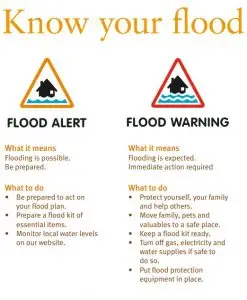
In the event of a flood focus on the safety of you and your family
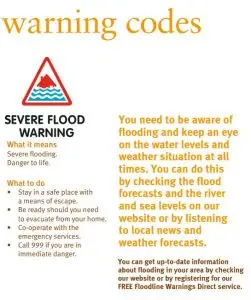
- Cooperate with the emergency services if they tell you to evacuate during flooding. • Be prepared to act quickly and get yourself to safety. We use our flood warning services to warn you of flooding from rivers and the sea as soon as we can. But there are some types of flooding we can’t predict. Stay alert to localised flooding also known as ‘surface water flooding’. This usually happens where drainage systems are unable to cope with heavy spells of rainfall. We cannot give you a direct warning for this type of flooding. Instead we forecast where it might be a problem in certain counties and put a daily flood risk forecast on our website. You can also find out about the possibility of ‘surface water’ flooding in your area by checking local weather forecasts.
What to do in an emergency, to stay safe
- Check in with other people in your household – if they are not at home make sure they are somewhere safe.
- Gather essential items together either upstairs or in a high place.
- Fill jugs and saucepans with clean water.
- Move your family and pets upstairs, or to a high place with a means of escape.
- Turn off gas, electricity and water supplies when flood water is about to enter your home if safe to do so. DO NOT touch sources of electricity when standing in flood water.
- Keep listening to local radio for updates or call floodline 0345 988 1188
- Check in with vulnerable neighbours or relatives.
- Flood water can rise quickly, stay calm and reassure those around you. Call 999 if you are in danger.
Important! Flood water is dangerous
- Six inches of fast-flowing water can knock over an adult and two feet of water can move a car.
- Avoid walking or driving through it.
- Keep children and vulnerable people away from it.
- Wash your hands thoroughly if you touch it.
Protect what you can
Move important items to safety and put flood protection equipment in place when there is a flood warning. Follow manufacturers’ instructions carefully to help stop or reduce the flood water entering your property.
Take items upstairs or to a safe place in your property
- Safely store important documents such as insurance papers.
- Move items of personal value such as photos, family films or treasured mementos. • Move lightweight household belongings you can pick up easily and quickly.
- Move items of furniture that are expensive or harder to repair before cheaper ones.
If possible, move your outside belongings to higher ground
- If the flood water hasn’t reached you, move your car to higher ground and move outdoor pets to safety.
Help stop water entering your home
- Put plugs in sinks and baths. Weigh them down with a sandbag, a pillowcase or plastic bag filled with garden soil, or a heavy object.
If you do not have non-return valves fitted
- Plug water inlet pipes with towels or cloths.
- Disconnect any equipment that uses water (like washing machines and dishwashers).
Stay safe, always listen to the advice of the emergency services and evacuate when told to do so
- Leave your home if the emergency services say so. Refusing to leave on their advice will put you, your family and those trying to help you at risk.
- When you are evacuated you will be taken to an evacuation centre run by your local council. Free food and bedding is provided. Bring spare clothing, essential medication and babycare items if you have an infant.
- Most evacuation centres will let you bring your pets. Take their food. Put cats and small animals in a pet carrier or secure box.
- People running the centres are trained to give you support and advice. They will help you through the stress of a flood and prepare you for what to do afterwards.
What to do after a flood
When you’re sure it’s safe to return to your home, take care when entering as there may be hidden dangers in floodwater such as sharp objects and sewage pollution.
If your supply hasn’t been switched off at the mains, do not on any account touch sources of electricity when standing in flood water. Get a qualified electrician to come to the property to switch off the power.
Cleaning up after a flood
In many cases, your insurance company can pay for professional help to clean up your property.
The clean-up will usually involve:
Pumping out water from your home using a generator
Cleaning and disinfecting the property. Avoid high pressure hoses as they can blast contaminated particles into the air.
Drying out the property with dehumidifiers.
Local councils can supply skips and advise you on disposal of sandbags as they may need to be treated as contaminated waste.
Home insurance and flooding
According to the Chartered Insurance Institute, the average household flood claim amounts to £50,000.
That’s a staggering amount of money to stump up if you were affected by flooding, so it’s wise to ensure that you take out a home insurance policy to cover your home and contents.
Check how much your policy covers you for flooding, if the policy replaces your items new for old, and if it has a limit on repairs.
Making a claim
You should inform your insurer about flooding as soon as possible.
They’ll let you know whether you should clean the property or if they will send professionals to do that for you.
Many policies also cover the cost of temporary accommodation where you can stay while clean-up and repairs are underway. This could be in a B&B or rented property.
Your insurance provider will send a loss adjuster to your property to inspect the damage and to confirm what repairs and replacements will be covered by your policy.
Keep a record of flood damage for future reference.
Mark the height of flood waters on the walls in every room affected.
Photograph or video all damage to your home and contents.
List all parts of the property and contents damaged and, if your policy covers it, all food spoilt too.
Even if you live in an area at risk of flood or have made a flood claim in the past, it should still be possible to get reasonably priced insurance thanks to the Flood Re scheme. Under the scheme, your insurer pays out if you make a valid claim for flood damage, but it can then claim back a proportion of the money from the Flood Re fund. This reduces the insurer’s financial risk, so it can offer you cheaper cover.
Further information
The Environment Agency has published a booklet with advice on how to prepare your property for flooding. See Prepare your property for flooding